


The OpenAI researcher whose instruction-following work fed into ChatGPT just opened early access to a frontier model that gives up string generation. Diogo Almeida’s TypeSafe AI launched Jev on September 15, 2026 as the first “System One model,” a system that returns typed decisions with probabilities instead of generated text.
Almeida’s launch post (link https://typesafe.ai/blog/introducing-system-one-models-and-jev) puts the problem in interface terms. Chat models emit strings, and software that has to classify, route, score, or branch still has to parse those strings, validate them, and recover when the shape drifts, which is a bad fit for code that fires under tight latency budgets.
Diogo Almeida on Latent Space: “Why I couldn’t build Jev at OpenAI.” Interview with TypeSafe’s co-founder and CEO.
Strings Were Never a Hot Return Type
In TypeSafe’s telling, the gap was a model class that takes unstructured state with an emphasis on structured program state, then returns values whose legal shapes were declared before the call ran.
Jev is TypeSafe’s first public model in that class, after two years in stealth on a new architecture.
It uses a parallel sampler that answers multiple questions in one query, and a training method the company calls Reinforcement Learning for Calibrated Decisions (RLCD).
RLCD is aimed at epistemically honest probabilities on those decision tasks rather than preferred chat writeups.
Choice, Score, and Noul Come Back in One Pass
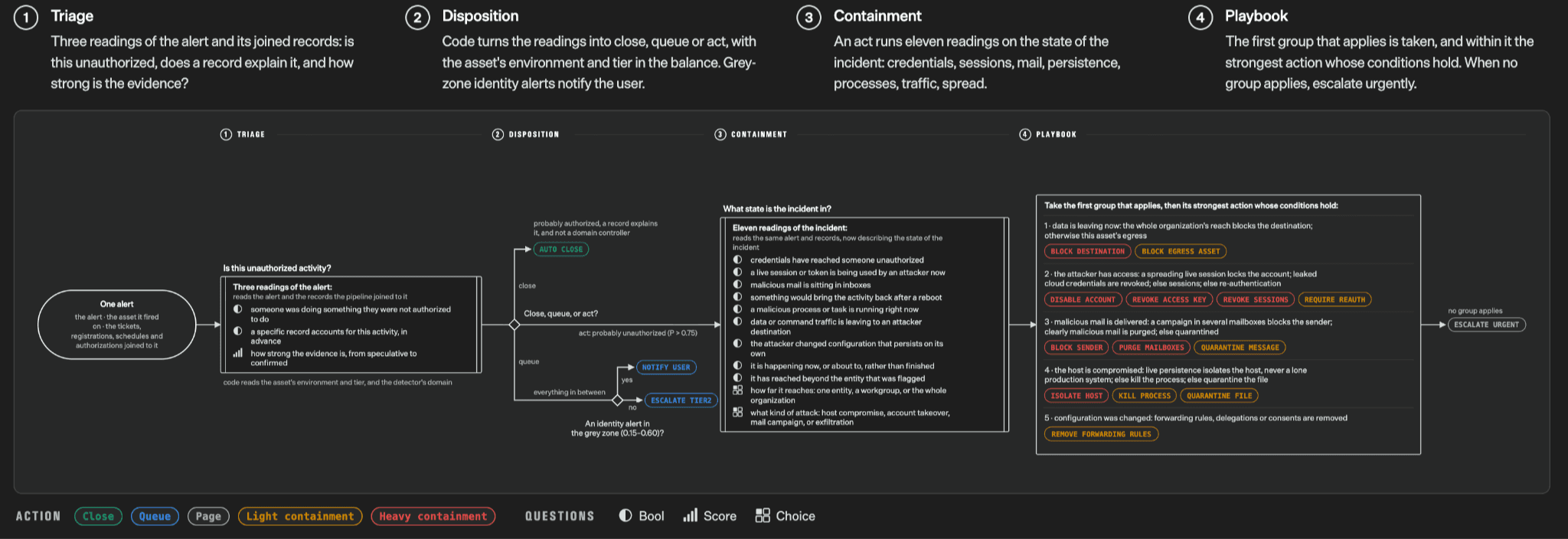
Callers send state as text, JSON, or related program data, plus a map of questions. Choice selects among named options the caller declares (cardinality up to 255), Score places the input on an ordered scale, and Noul returns a yes/no probability.
The answers come back together in one pass, each with calibrated confidence, because the sampler is parallel rather than token-by-token.
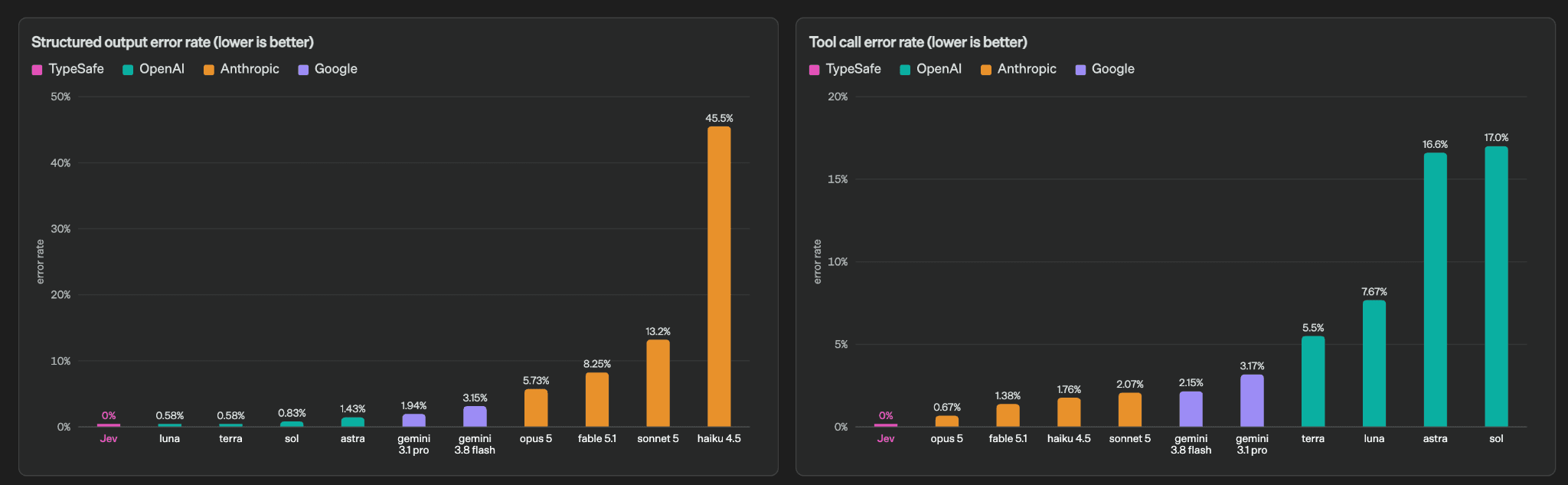
Because the legal outputs are fixed in advance, TypeSafe says type errors are mathematically impossible and treats schema mismatch as a 0% rate by construction on its charts.
Schema match is locked on TypeSafe’s charts. Correctness remains an evaluation problem for whoever ships the workflow.
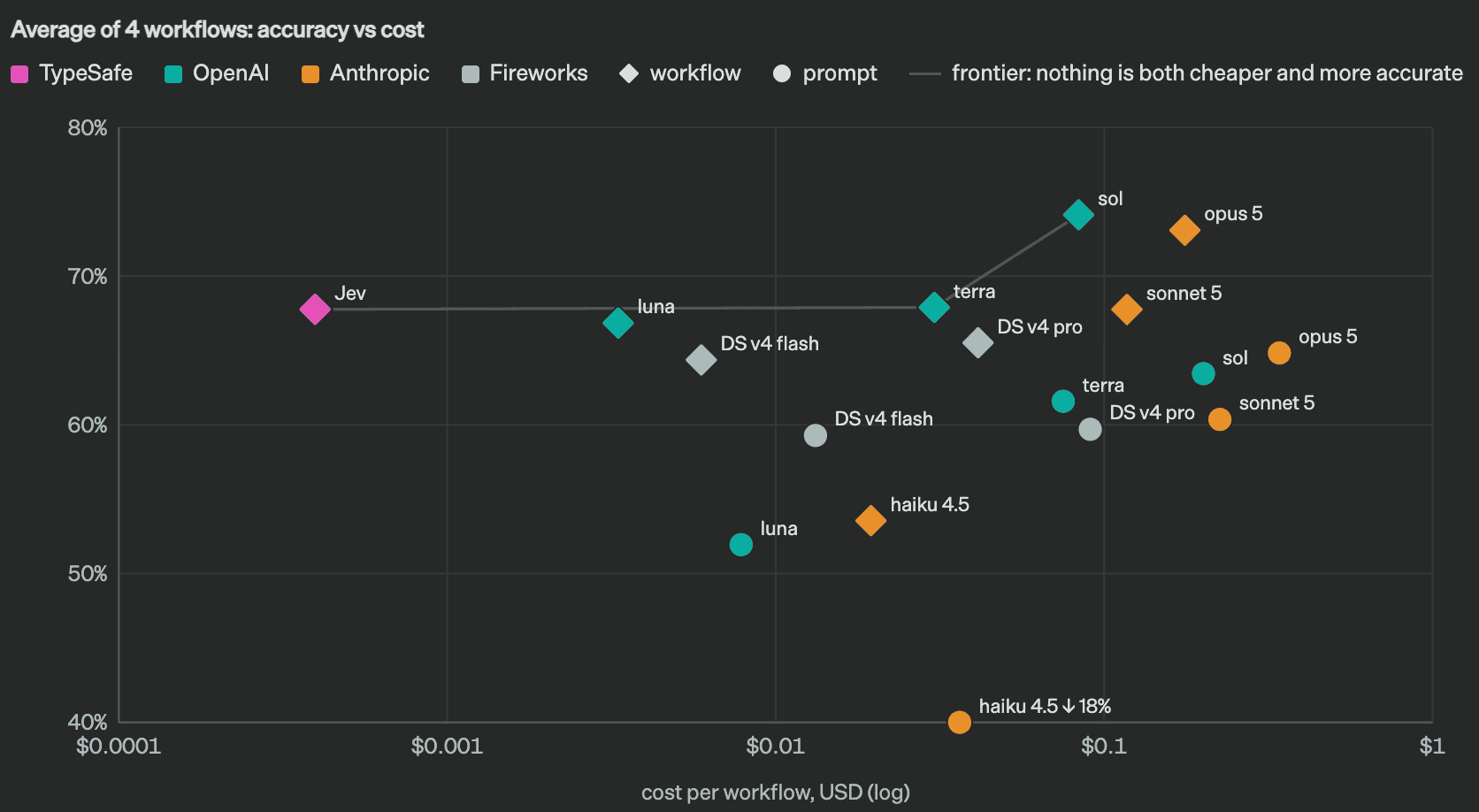
TypeSafe’s Pareto Numbers Are Their Evidence
Our team at TechForward has not run an independent harness against these claims. TypeSafe publishes end-to-end latency of 70–500 milliseconds for System One shaped queries, input pricing of $0.042 per million tokens, and free output tokens.
On the same class of task, the company says that is roughly 40× to 200× faster than frontier LLMs, with homepage figures of 193.6× faster and 444.6× cheaper drawn from its own workflow evals.
Those evals fix a compute graph in code, then score models against averaged frontier references. On that harness, TypeSafe places Jev on a company-drawn Pareto frontier for almost two orders of magnitude of speed and cost.
TypeSafe notes the workflows were written by its capabilities team and were not in training distribution. It also says the headline multipliers sit toward the high end of what it expects in the wild.
“System One” borrows Kahneman’s fast lane. The name Jev points at William Stanley Jevons and the rebound idea that cheaper coal meant more coal burned, so cheaper intelligence may mean more decisions worth automating.
Leave Generation to LLMs; Point Jev at the Branch
TypeSafe’s own use-case map keeps open-ended generation on LLMs and points Jev at structured steps inside workflows: classify, route, score, extract, guardrail, and jailbreak detection under real-time budgets.
That split tracks what we have already covered on the generation side, including when OpenAI put GPT-OSS weights in your hands for local reasoning and structured task execution, which still starts from a text-generating model rather than a typed decision return.
Early access opened off a waitlist on launch day, with more developers admitted later the same week as capacity allowed.
Independent public benches against open classification suites are still thin next to the launch charts. Until someone else’s harness agrees, treat the Pareto plot and the homepage multipliers as company claims.
If you are wiring this into an agent stack, the same discipline shows up in how teams package reusable judgment as modular agent skills: keep the hot classify-or-route call small, and leave the long-form work elsewhere.
Pin One Classify-or-Route Step and Measure It
A researcher who helped teach models to follow instructions just shipped a frontier-class system that refuses to answer in free text. Typed decisions on the classify-or-route step still feel overdue when teams are glued to structured-output chat, and that is why this launch stuck with our team at TechForward.
Jev is TypeSafe’s first public System One model, returning typed decisions with probabilities in one pass. TypeSafe says schema match is guaranteed by construction on its charts. The speed and cost figures are company-drawn, and we have not audited them ourselves.
If those Pareto numbers look even halfway real outside TypeSafe’s harness, skip another chat wrapper. Pin one production classify-or-route step that still depends on string generation, express it as Choice, Score, and Noul against the same state, and compare latency, cost, and label agreement at the confidence cutoff you already trust.
Read Almeida’s System One and Jev launch, try the product at jevai.net, skim the TypeSafe docs, and when you are ready to measure it yourself, hit the System One HTTP API with a pinned model ID so aliases do not move mid-eval.