


Mistral AI built a forecasting model that returns a day-ahead prediction in 113 milliseconds on eight CPU threads, and any company booking more than $20 million in a month needs a separate deal before it can use the weights. Timestral, the first time series foundation model family from Mistral, shipped on Hugging Face in four sizes (5M, 28M, 123M, and 209M parameters) alongside an October 15 launch post. The technical report landed on arXiv October 27 with the full benchmark tables, the architecture, and the latency curves behind the launch post’s 17 and 113 millisecond figures.
Time series forecasting runs capacity planning, energy dispatch, supply chains, and maintenance schedules, and most of those teams fit one statistical model per series. Foundation models such as Chronos-2, TimesFM-3, and Toto-2.0 promise zero-shot forecasts on series they have never seen. Mistral now claims the top of that table with a model smaller than the two strongest rivals it names.
The Top Spot Comes Down to Fractions of a Point
The report scores every model on three public benchmarks, GIFT-Eval, TIME, and fev-bench, with two metrics each. Timestral-209M posts a GIFT-Eval MASE of 0.6575 against 0.6608 for t0-gamma, a 256M-parameter model, and 0.6668 for the 331M-parameter TimesFM-3, according to Table 3 of the report. On fev-bench, Timestral-209M scores a 50.39% SQL skill score against 49.42% for t0-gamma and 48.99% for TimesFM-3. Mistral reports first place on all six metrics for the 209M model and second place on all six for Timestral-123M.
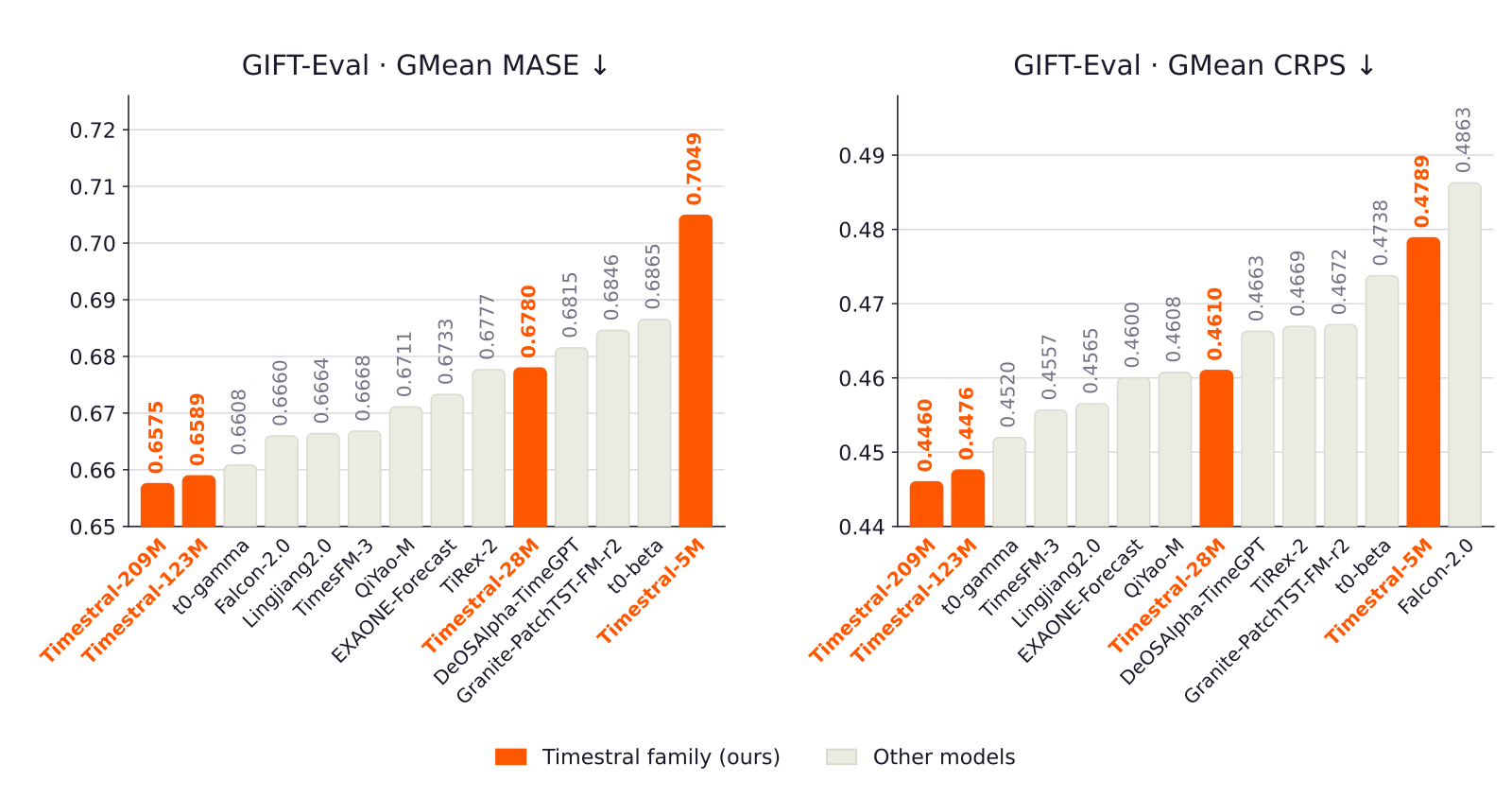
The leads are thin. The GIFT-Eval MASE gap to t0-gamma works out to about half a percent, and a benchmark refresh or a new rival checkpoint could reorder the top three within weeks. The smaller sizes make the stronger claim. The report says Timestral-28M beats Chronos-2 and Toto-2.0-2.5B, about 4 and 90 times larger, on all six metrics, and that the 5M model beats every Toto-2.0 size on fev-bench, including one with about 480 times as many parameters.
Mistral also ran an industrial benchmark, IND-Eval, which covers 187 tasks in energy, manufacturing, and transport. There Timestral-209M scores an aggregate normalised MASE of 0.646 against 0.697 for t0-gamma, which the report calls about 7% lower error. Mistral ran every IND-Eval comparison itself with public checkpoints, so that margin comes from the vendor and not from a leaderboard. The Hugging Face model card lists its benchmark scores as self-reported, and the launch post says results were submitted to the GIFT-Eval and TIME leaderboards. Our team at TechForward has not rerun any of the numbers.
Forecast Tokens Read the History Without Erasing It
The architecture change Mistral leads with is Decoupled Horizon Forecasting, or DHF. Causal models such as TiRex, Toto-2.0, and TimesFM-3 learn multi-step forecasts with contiguous patch masking, which hides stretches of the input during training so the model learns to predict several patches ahead. The report points out the cost of that trick, since every masked patch also disappears as context for every later forecast in the same training sequence.
DHF gives each patch two tokens during training. A context token keeps the observed values visible to later forecasts, and a separate prediction token reads the history before its forecast block, while context tokens never attend to prediction tokens. Every observed value serves as both a forecast target and context, and real gaps in the data stay flagged as missing instead of looking like forecast positions. The report says the price is roughly double the token count during training. At inference, the model produces up to 1,024 time steps in one forward pass from up to 32,768 steps of history.
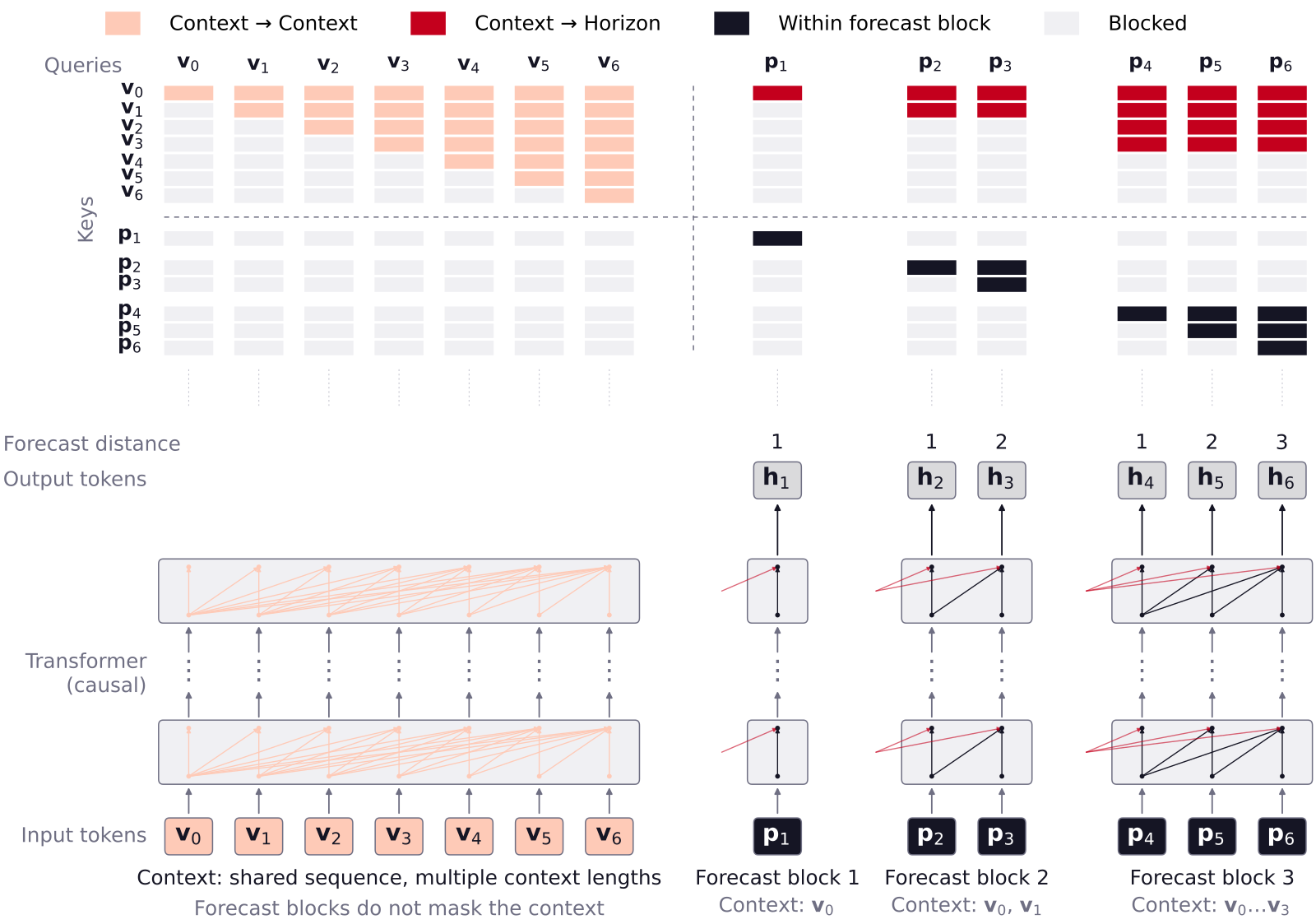
Covariates get the same treatment through attention masks. Each input series is tagged as a target, a past-only covariate, or a known-future covariate, and information flows from covariates to targets but never back. A production schedule, a holiday calendar, or a weather forecast can inform the forecast without leaking the target series into its own future, according to the report.
Training runs in two stages. Mistral pretrained all four models only on synthetic series at a context of 8,192 steps, then post-trained on a mix of real and synthetic data at 32,768 steps. The report does not name the real datasets, the training compute, or the share of real data in post-training, so readers cannot check for overlap between that real data and the benchmark test sets.
100,000 Series Every 15 Minutes on as Few as Two CPU Cores
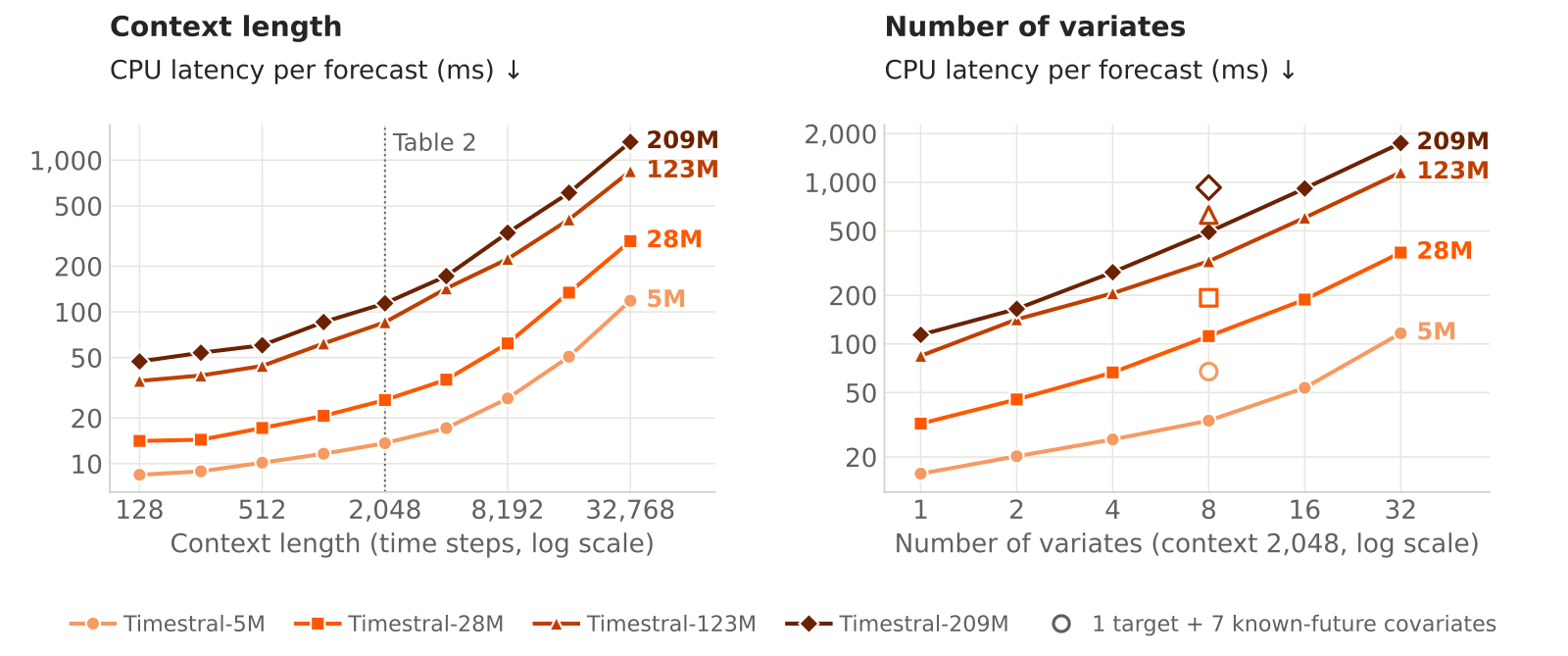
Mistral benchmarked a 96-step forecast of a univariate series from 2,048 steps of 15-minute history, about three weeks, on an AMD EPYC 9454 server CPU. On eight threads, a forecast takes 17 ms with Timestral-5M and 113 ms with Timestral-209M, according to Table 2 of the report. Checkpoints range from 21 MB to 837 MB in float32.
Throughput on a single CPU core runs from 3.5 series per second for the 209M model to 106 for the 5M model. By the arithmetic in the report, forecasting 100,000 series every 15 minutes takes 2 to 32 cores depending on model size, and one NVIDIA H100 clears the same 100,000 series in 5 to 27 seconds. The middle sizes give teams room to trade. Timestral-123M lands about 0.2% behind Timestral-209M on GIFT-Eval MASE at 75% of its latency, and Timestral-28M runs 3.6 times faster than the largest model.
Long contexts and many variates cost real time. At the full 32,768-step context, Timestral-209M needs 1.3 seconds per forecast, and a series with 32 variates takes 7 to 15 times as long as a single one, the report says.
The License Draws a Line at $20 Million a Month
The inference code on GitHub ships under Apache 2.0. The weights ship under a Modified MIT license that bars any company, or the employer of any user, with global consolidated monthly revenue above $20 million in the preceding month. The clause covers derivatives and fine-tuned versions, and the license file points larger companies to Mistral sales for a commercial license or to hosted Mistral services.
The license puts the enterprise buyers in the launch post, the plant operators and finance teams, on the paid side of the line. Mistral offers Timestral through Mistral Forge for fine-tuning on proprietary data, with deployment on customer hardware including air-gapped sites, according to the launch post. Mistral has not published Forge pricing for Timestral.
A Small Model With a Sales Call Attached
The benchmark lead is narrow. The CPU numbers are wide, and those numbers stuck with our team, since a 5M model that answers in 17 ms changes who can afford to forecast every sensor in a plant.
Small companies can pull the weights today. Larger ones get a zero-shot trial on their own data and then a conversation with sales. Read the launch post and the technical report on arXiv, grab the weights from the Timestral collection on Hugging Face, run the inference code on GitHub, read the weights license before anyone in a large company installs it, and check the live standings on GIFT-Eval, TIME, and fev-bench. For more on small task-specific models, see our look at TypeSafe Jev, a System One decision model, and for a different open-weights license, our coverage of the OpenAI gpt-oss release under Apache 2.0.