

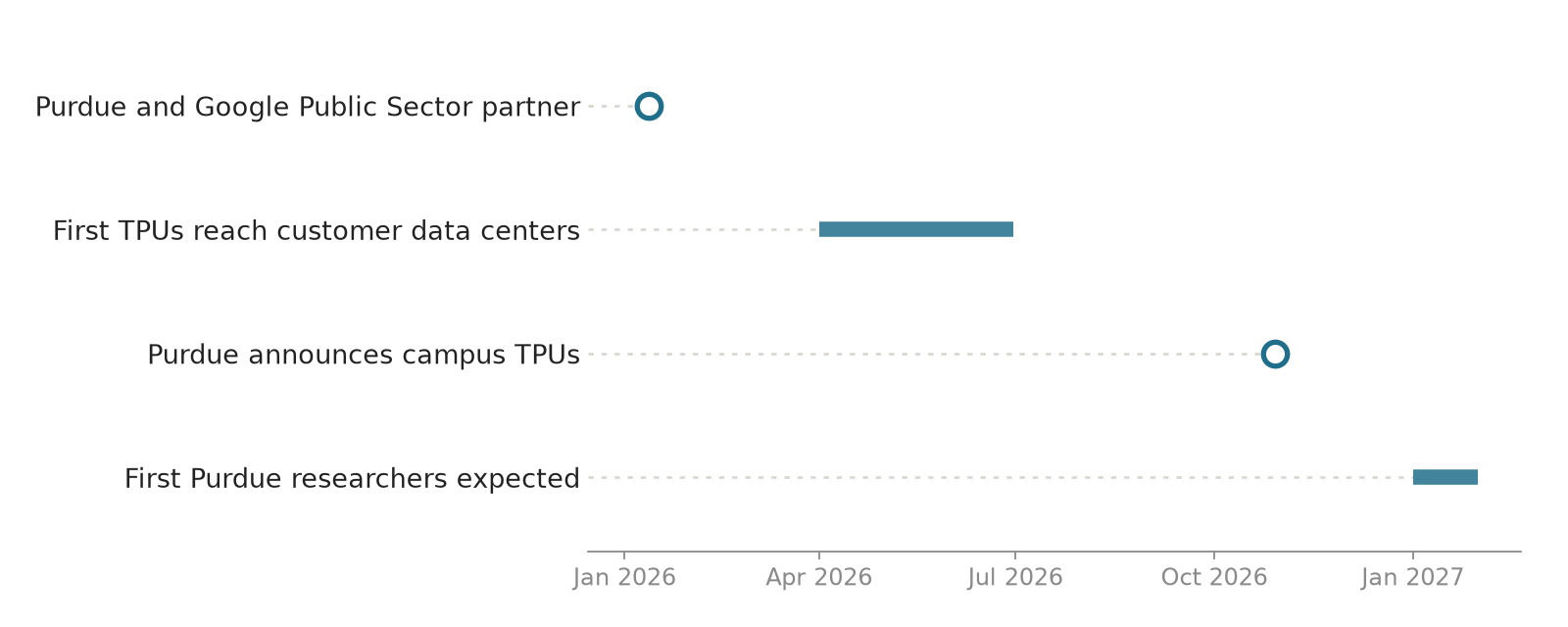
Imagine having Google TPUs as AI accelerators in your own on-premises or sovereign AI infrastructure. Google TPUs in a customer’s own data center would have sounded bizarre 3 years ago, but today they’re a reality. On October 29, Purdue University announced Google TPUs for its own data center. Purdue says the TPUs add 30 percent to its AI capacity, with first researchers expected in January 2027.
Google Now Ships TPUs to Customer Data Centers
Purdue’s January 12 partnership with Google Public Sector included TPU access and a five-year commitment to Google’s GPAR research program. Google Public Sector CEO Karen Dahut said then that Google was “providing Purdue with Google Cloud’s AI infrastructure and TPUs.” Google’s TPU strategy had centered on giving customers access to the chips through Google Cloud, Network World reported in July.
Alphabet CFO Anat Ashkenazi said Google “delivered to customer data centers for the first time” in Q2, per Network World. In April, Alphabet CEO Sundar Pichai named high-performance computing applications as a TPU demand source. Pichai told analysts select customers would get TPUs “in their own data centers,” DCD reported. On November 9, Google SVP Amin Vahdat counted nearly 100 TPU customers including universities and named customer data centers the newest use case.
Purdue Will Run the TPUs Inside Its Community Cluster Program
Rosen Center for Advanced Computing (RCAC) executive director Preston Smith said Purdue is working with Google Public Sector, Cirrascale and DDN on the TPUs. Smith added that the TPUs will join Purdue’s “long-running community cluster” program, with Purdue “operating it within our existing business.” Purdue says it will be the first U.S. academic institution to provide TPUs to researchers “as part of its campus computing program.”
Purdue affiliates have invested several million dollars in shared compute and storage since Q4 2006, according to RCAC’s community clusters page. RCAC administrators handle security patches, operating system upgrades and hardware repair for those clusters. Purdue also says it maintains institutional control over data, security and governance. I find the familiar cluster model the most encouraging part of Purdue’s plan.
Purdue Partner Cirrascale Lists On-Prem Deployments With a Fully Managed Option
Cirrascale announced on March 10 that it would serve as an implementation and services partner for GPAR. Cirrascale launched Cirrascale Government Services the same day, listing hybrid, on-prem and colocation deployments with a fully managed operations option among its focus areas.
Purdue’s release doesn’t break down what Cirrascale and DDN each supply, and I’m looking forward to that detail. I’d watch Cirrascale’s press page for a Purdue write-up, since that breakdown would help any campus planning a similar build.
The TPU Generation Purdue Installs Will Shape Serving Speed and Cost
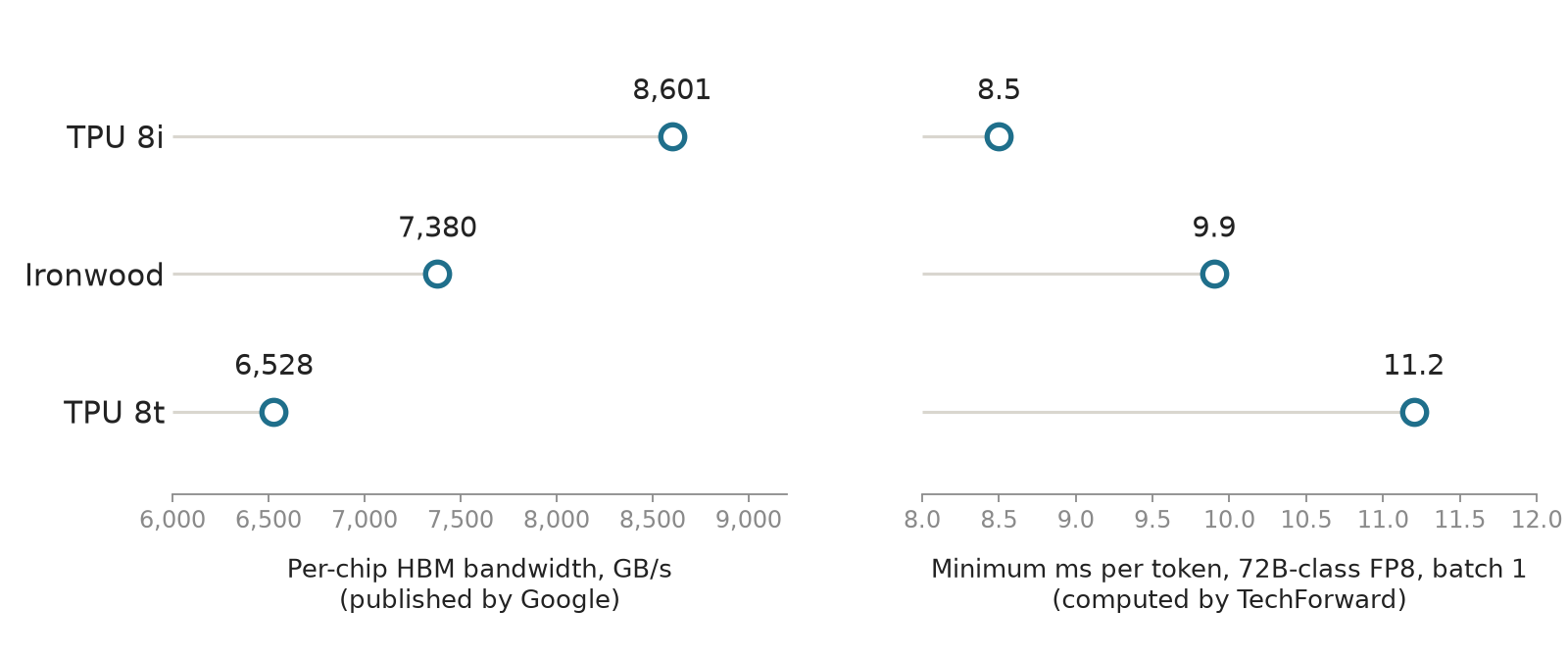
Smith described the target workload as “ambitious training and inference work.” Google lists per-chip memory bandwidth of 8,601 GB/s for TPU 8i, 7,380 for Ironwood and 6,528 for TPU 8t. We tied small-batch decode pace to memory bandwidth in our look at TPU 8i serving, so Purdue’s chip choice shapes serving speed. At batch size 1, a 72B-class FP8 model needs at least 8.5 ms per token on TPU 8i, by our math. Ironwood’s minimum is 9.9 ms and TPU 8t’s is 11.2 ms, 2.7 ms slower than TPU 8i.
Google’s Cloud TPU page listed Ironwood as generally available at the time of this writing. Google describes Ironwood as built for training, reasoning and inference. The same page listed four eighth-generation systems as coming soon, including TPU 8t for large-scale pre-training and TPU 8i for post-training and inference. As the newest generally available generation, Ironwood is my first porting target. I’m keeping TPU 8t and TPU 8i on my watch list for Purdue’s install.
Google’s pricing page listed Ironwood at $12.00 per chip-hour on demand in us-central1 at the time of this writing. Google’s sixth-generation Trillium cost less on the same page, at $2.70 per chip-hour on demand in us-east1. Purdue and Google hadn’t published on-site TPU purchase pricing yet. I’d budget with Ironwood’s $12.00 cloud rate as a rental benchmark, then add eighth-generation costs once Google lists prices.
PyTorch and JAX Already Run on Cloud TPUs
I’d finish a first port before January 2027, when Purdue expects initial researchers on the TPUs in its Mathematical Sciences Building Data Center. Google’s TPU page says TPUs support PyTorch and JAX natively, along with the vLLM inference engine.
Google also lists TorchTPU, an open source PyTorch backend for training and serving on Cloud TPUs without learning a TPU-specific API. Google’s TPU architecture docs say the same code can run on different TPU versions that have the same number of TensorCores or chips. I’d treat working Cloud TPU code as a head start for a campus system.
Port Two Jobs to Cloud TPUs Now and Be Ready for Campus TPUs
Google TPUs in a customer’s own data center are no longer imaginary, since Purdue expects its first researchers on them in January 2027. I’d start by porting one training job and one inference job to JAX or TorchTPU on Ironwood. Next, I’d ask the Rosen Center which TPU generation Purdue is installing and what each partner supplies. I’d also ask whether the campus stack matches Cloud TPU software. Then I’d check RCAC’s purchase page for a TPU option, which wasn’t listed at the time of this writing. Last, I’d follow RCAC news for the January 2027 start.
I’d read Smith’s quotes in Purdue’s release, starting with his plan for running TPUs “within our existing business.” Our team at TechForward is eager to see the first research results from Purdue’s campus TPUs.